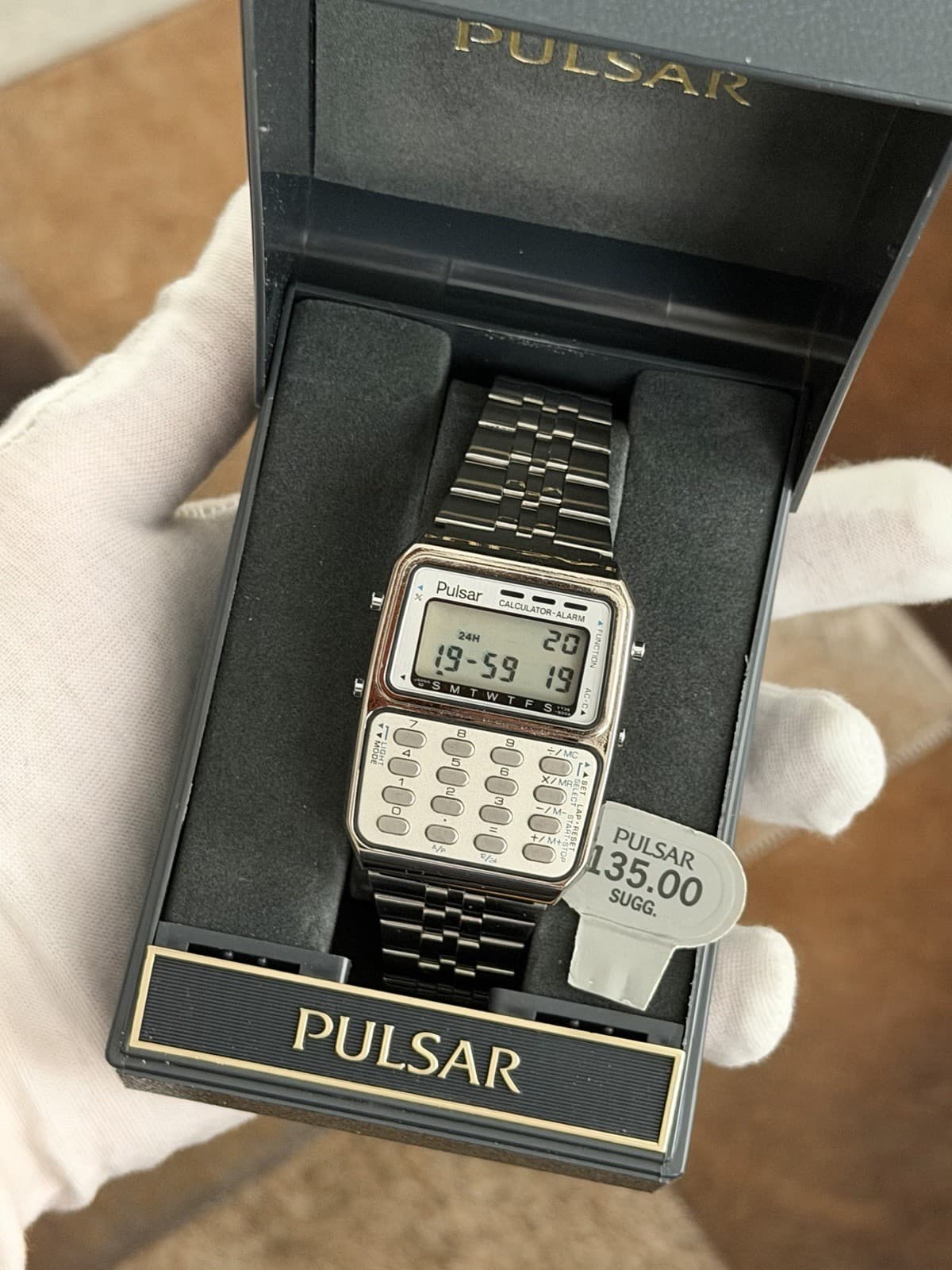
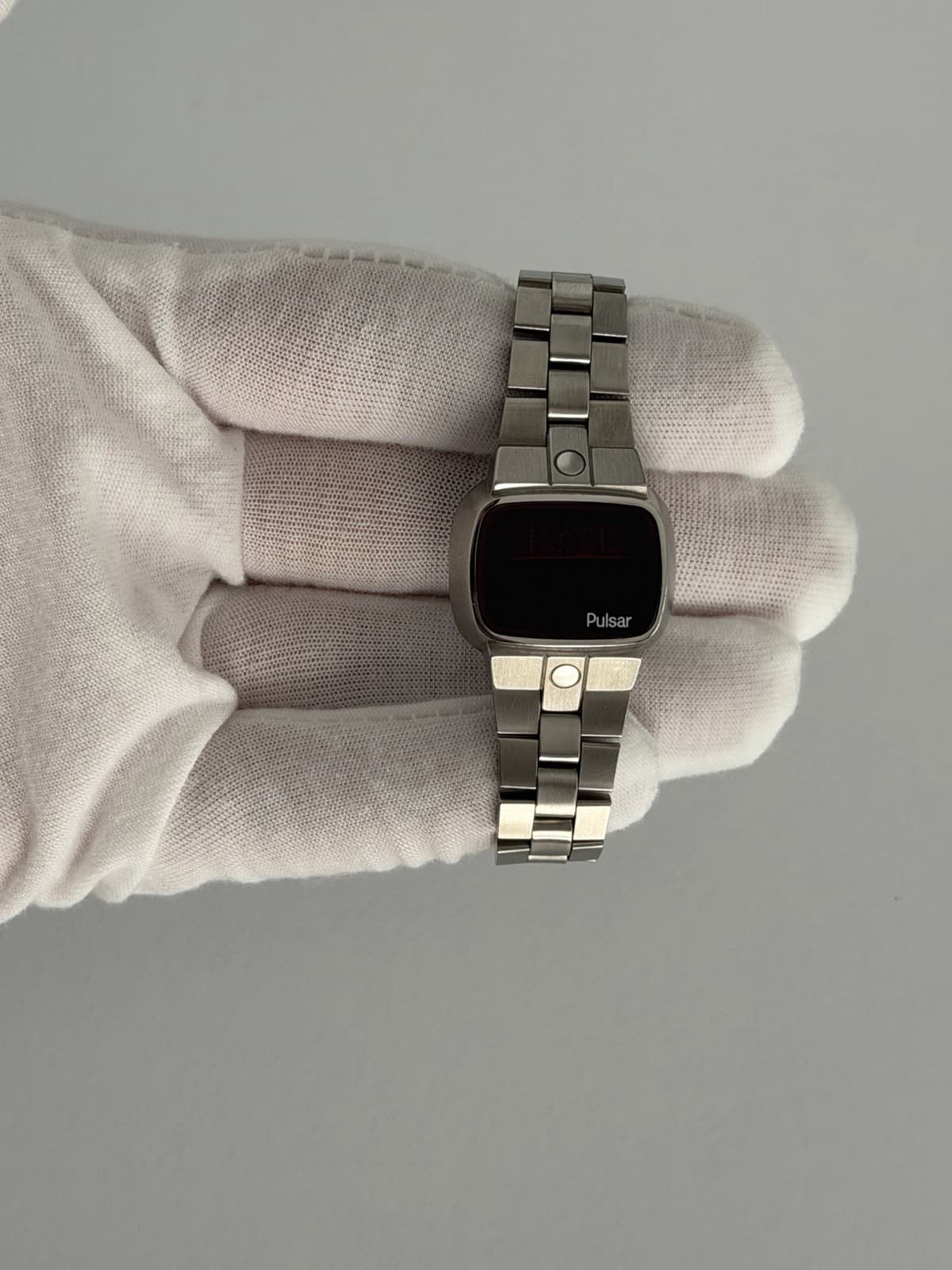
Pulsar Alarm Chrono Game Y760-5039 Men’s Vintage Digital Sports Watch JDM 1980s
► FREE US SHIPPING — $30 FLAT INTERNATIONAL
Seiko Pulsar
Quartz
1980-1989
Stainless Steel
Gold
Stainless Steel
► SELLER'S DESCRIPTION
ADDITIONAL SPECIFICATIONS
► ARCHIVE FILE: PULSAR — BRAND HISTORY
Pulsar began as Hamilton's 1972 LED watch, the first electronic digital wristwatch sold, became Seiko's lower-priced quartz line after a 1978 sale, and has been quietly wound down by Seiko since 2019.
Read the full Pulsar story ►
George Thiess was wearing a $10.95 Timex when he decided a watch needed no hands. His Garland, Texas firm, Electro/Data, could build the electronics that had stumped Hamilton in Lancaster, Pennsylvania; in 1969 they split the job, Texas inside, Lancaster outside. Hamilton named it Pulsar, after the pulsing star, and unveiled it in New York on May 6, 1970; Johnny Carson showed a prototype on The Tonight Show. Press a button and red numerals lit for a moment.
The Pulsar Time Computer, the first electronic digital wristwatch anyone could buy, went on sale on April 4, 1972, in 18-karat gold at $2,100. A steel version, the P2, followed, and in 1973 Roger Moore checks the time on his in Live and Let Die. By Christmas 1974 jewelers displayed a blown-up photo of President Ford wearing his. A year later came the Pulsar calculator, solid gold at $3,950.
Cheap chips ended it. HMW, Hamilton's parent, sold the Hamilton name to the Swiss in 1974 and kept Pulsar in Lancaster as Time Computer. Texas Instruments showed a $20 plastic LED watch in 1976, and Pulsar ended the year millions in the red. The brand went in 1977 to Rhapsody, a watch distributor, and in 1978 to Seiko, whose American arm put the name on quartz watches a rung below its own. By 1997 the United States was its largest market, with Pulsars from $50 to $300.
The name still belongs to Seiko in Tokyo, so Hamilton's 2020 reissue of the P2 is called the PSR. Seiko UK dropped Pulsar in 2019; in October 2026 Seiko's American and British sites list neither Pulsar nor Alba. Thiess, who gave his prototype to the Smithsonian in 2011, died on August 15, 2026, at 95. Seiko made Pulsars for forty years, so most survivors are quartz numbered the Seiko way, caliber then case; a Hamilton-era LED with red numerals is the rare exception.