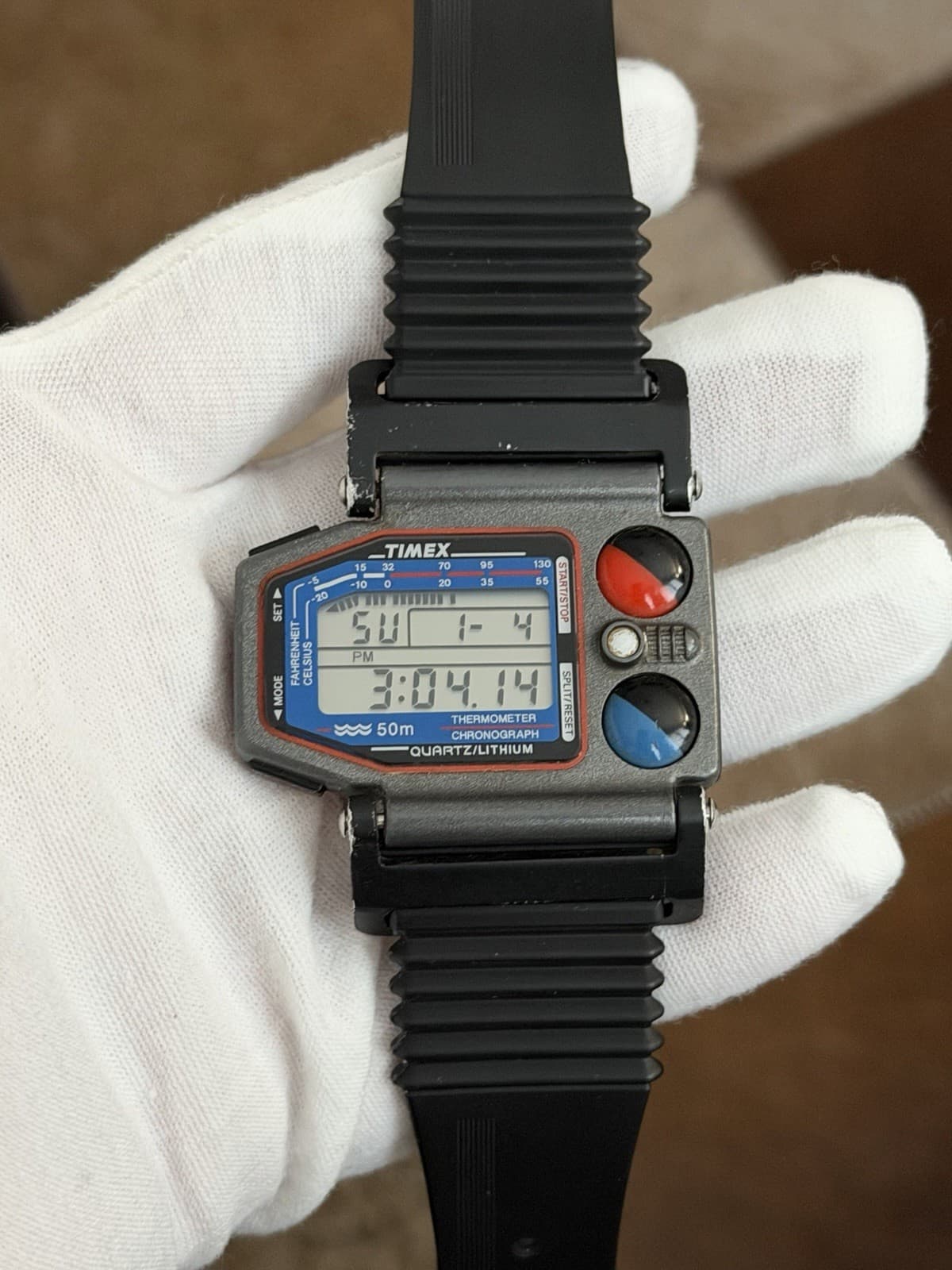
Rare Vintage Timex Skiathlom Men’s Digital Thermometer Sports Ski Watch 1980s
DESCRIPTION
► ARCHIVE FILE: TIMEX — BRAND HISTORY
Timex descends from the Waterbury Clock Company, founded in 1854 in Connecticut's Naugatuck Valley, a region so dense with clockmakers it was called the Switzerland of America. Waterbury helped invent the cheap, honest American watch: the Ingersoll Yankee of 1896, built by Waterbury and sold for one dollar, was advertised as the watch that made the dollar famous, and the Mickey Mouse watch of 1933 sold so well it pulled the company through the Depression.
Control passed in the early 1940s to two Norwegians who had fled the German occupation, shipowner Thomas Olsen and engineer Joakim Lehmkuhl, and the firm was renamed United States Time Corporation in 1944. The Timex brand arrived in 1950: simple, rugged movements using hard Armalloy bearings in place of jewels, built to be accurate, durable, and inexpensive. Live television torture tests hosted by John Cameron Swayze, with the tagline that a Timex takes a licking and keeps on ticking, made it a household name, and by the early 1960s roughly one of every three watches sold in the United States was a Timex.
The vintage catalog runs deeper than its price point suggests. The hand-wound Marlin of the 1950s and 1960s is the emblematic piece, a clean, durable everyday watch whose 2017 reissue introduced a new generation to the originals. Electric models arrived in 1960, quartz followed in the 1970s, and in 1986 the Ironman Triathlon, an eight-lap memory sports watch, became the best-selling watch in the United States and a fixture on famous wrists, including a sitting president of the United States.
Collecting Timex is the most democratic corner of the hobby. Dials from the 1960s and 1970s usually carry a catalog number at the bottom edge whose final two digits give the year of manufacture, which makes dating straightforward. Because the watches were built to be serviced cheaply or simply replaced, survivors with clean dials and strong-running movements are scarcer than the production numbers imply. Marlins, Viscounts, and early Ironmans cost little, carry real history, and are honest entry points into mechanical and early digital collecting alike.