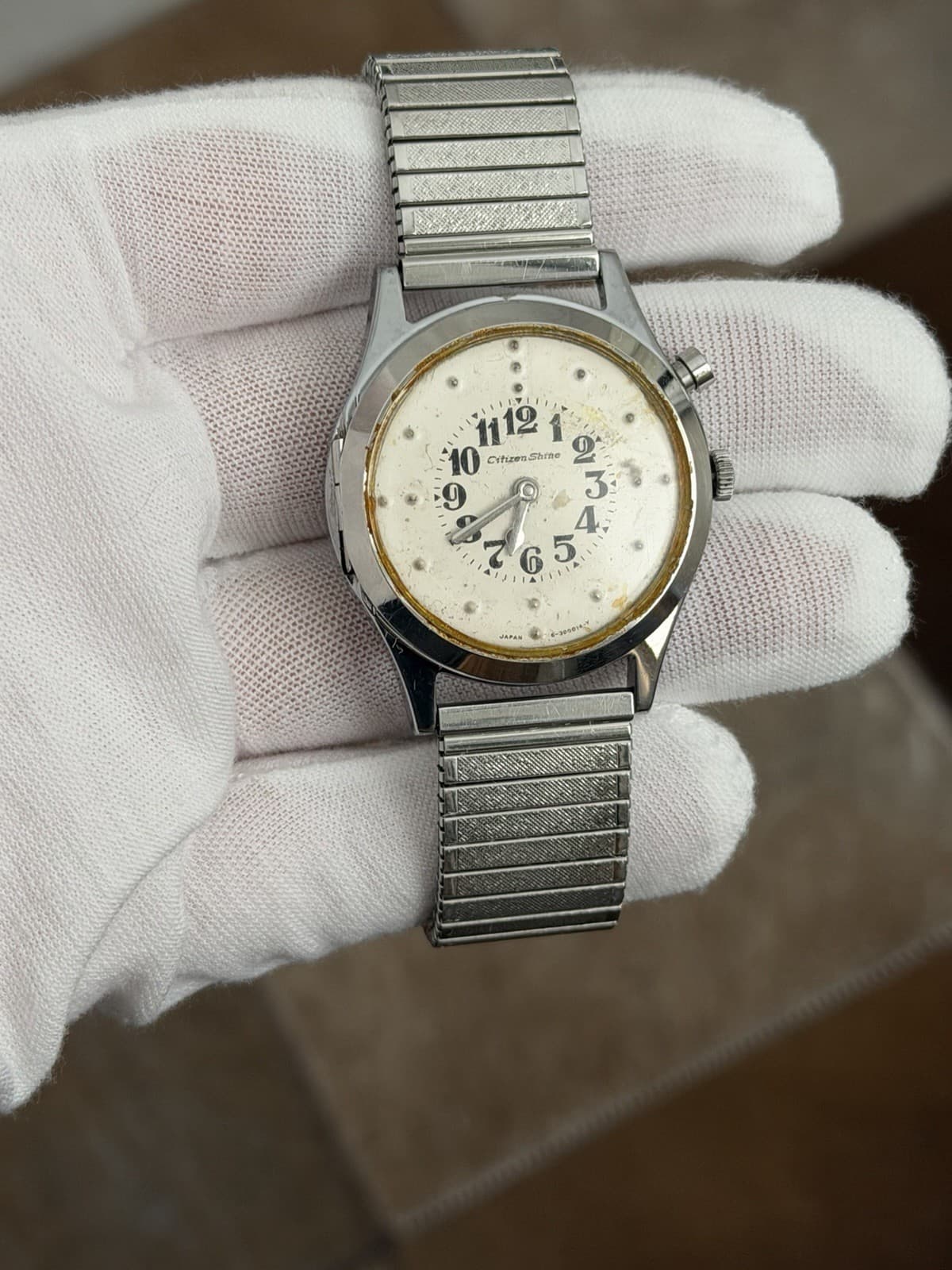
Rare Vintage Citizen Shine Manual Wind Men’s Flip Top Braille Watch JDM 1960s
DESCRIPTION
► ARCHIVE FILE: CITIZEN — BRAND HISTORY
Citizen traces to the Shokosha Watch Research Institute, founded in Tokyo in 1918. Its first product, a pocket watch completed in 1924, was christened CITIZEN, a name encouraged by Tokyo mayor Shinpei Goto in the hope that the watch would be close to the hearts of ordinary people. Citizen Watch Co. was formally established in 1930, and through the postwar decades it grew into one of the two pillars of Japanese watchmaking alongside Seiko, eventually ranking among the largest watch producers in the world.
The company built its reputation on engineering firsts. Parashock, Japan's first shock-resistant watch, arrived in 1956 and was famously proven by dropping watches from a helicopter. Parawater followed in 1959 as Japan's first fully water-resistant wristwatch; Citizen strapped examples to buoys and set them adrift across the Pacific to prove the seals. In 1970 the X-8 Chronometer became the world's first watch cased in titanium, and in 1976 Citizen introduced the first light-powered analog quartz watch, the technology later branded Eco-Drive in 1995.
Citizen's vintage sports catalog runs deep. The Challenge Diver of the late 1960s earned legend status when one example, lost off the Australian coast and recovered on a beach months later covered in barnacles yet still running, became the centerpiece of Citizen advertising; collectors still call the model the Fujitsubo, Japanese for barnacle. The bullhead chronographs powered by the 8110 caliber, with crown and pushers at twelve, and the high-beat Leopard automatics running at 36,000 beats per hour showed Citizen could match anyone on mechanical performance.
For collectors, vintage Citizen remains undervalued next to comparable Seiko, which makes it fertile ground. Serial numbers stamped on most case backs encode the year and month of production, original dials matter far more than cosmetic polish, and the parts situation favors common automatic calibers with long production runs. Bullheads with unrestored dials, early divers, and honest Parawater-marked pieces from the early 1960s are the ones worth holding, and prices for all of them have been climbing as the catalog gets rediscovered.